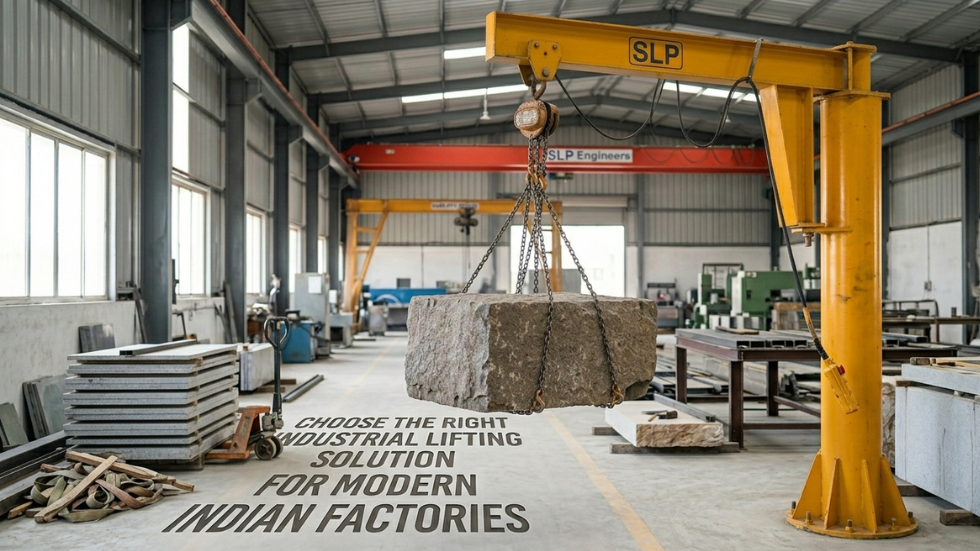
Deciding on the best machinery for a production floor involves more than just looking at weight capacities. In many workshops across India, the layout of the building and the height of the ceiling determine which equipment will actually fit. Owners often find that a single large machine cannot handle every task, especially when workers need to move parts quickly between different stages of production.
When someone walks through a stone processing unit or a fabrication shop, they usually see various stations where heavy items are lifted, turned, and placed. If the work happens within a fixed circular area, a Jib Crane is often the most practical tool to install. These machines don’t require the entire ceiling to be reinforced and can be placed exactly where the heavy lifting happens most frequently.
How Localized Lifting Improves Workflow
In a busy factory, waiting for a single large overhead machine to move a small part is a common cause of delays. Many supervisors notice that providing each station with its own lifting tool keeps the line moving. This is where an Arm Crane becomes a valuable addition to the floor. These are usually smaller and more agile, allowing an operator to precisely position a heavy component onto a machine bed without needing extra help from other staff members.
SLP Engineers observe that the choice often depends on how much floor space is available. If the ground is already crowded with raw materials and cutting machines, a pillar-mounted system might take up too much room. In these cases, mounting the lifting equipment to a structural wall or an existing support column helps maintain a clear path for workers and trolleys.
Managing Large Scale Material Handling
When the task involves moving a multi-ton load from the loading dock to the far end of the warehouse, a stationary pivot machine will not reach. This situation usually requires an EOT Crane to bridge the gap. These systems run on elevated rails and cover the entire rectangular footprint of a shed. They are the heavy hitters of the industrial world, designed to carry massive weights that smaller units simply cannot manage.
While these overhead systems are powerful, they are a permanent part of the building’s infrastructure. Installing them involves significant structural planning. Many factory managers prefer to use these for the initial movement of raw materials and then rely on a Jib Crane at individual work centers for the more detailed, repetitive lifting tasks. This prevents the large overhead system from being tied up with small jobs all day long.
Factors Influencing the Final Decision
Choosing between these machines usually comes down to the frequency of the lifts and the specific path the load needs to take. If a worker needs to pick up a stone slab, rotate it 180 degrees, and place it on a polishing table, the Jib Crane is usually the most efficient choice. Its ability to swing in a full or partial circle makes it very easy for a single person to handle awkward loads safely.
In many Indian industrial zones, SLP Engineers find that environmental factors like dust and heat also play a role in equipment selection. Machines with fewer complex moving parts are often easier to maintain in these conditions. A standard Jib Crane is relatively simple in its design, which means there are fewer things that can go wrong during a high-output shift.
- Pillar Mounted: Best for open floor plans where 360-degree rotation is needed.
- Wall Mounted: Saves floor space by utilizing existing building supports.
- Portable Units: Can be moved between different areas of the factory as needs change.
Strategic Planning with SLP Engineers
Most successful factory layouts use a combination of different tools rather than relying on just one. By placing a Jib Crane at each major workstation, a company can reduce the risk of injury and speed up the production process. SLP Engineers focus on providing robust machinery that can handle the daily grind of a heavy industrial environment. Over time, it becomes clear that the best setup is one that matches the machine to the specific physical task. Whether it is a heavy-duty Jib Crane for a stone yard or a specialized lifting arm for a precision workshop, having the right tool in the right place is what keeps a business competitive. SLP Engineers continue to help factory owners across the country optimize their space with these practical lifting solutions.
Contact Us
Business Name – SLP Engineers
Visit Stone Cutting Machines Supplier – https://slpengineers.com/
Address – G1, 118 Road No. 3C, BIA Kaladwas, Eklingpura, Udaipur, Rajasthan, India – 313003
Phone No. – +91 96603 60972
E-Mail – slpengineers01@gmail.com
